
Bob Willard Weighs in on His Favorite Lincoln Site

By Bob Willard
Washington, DC
Monday, June 8, 2026
[Editor's Note: The Abraham Lincoln Association recently posted on its Facebook page the following query: What's your favorite Lincoln-related historical site and why? LGDC member Bob Willard weighed in with his favorite site...and it's right here in Washington, DC.]
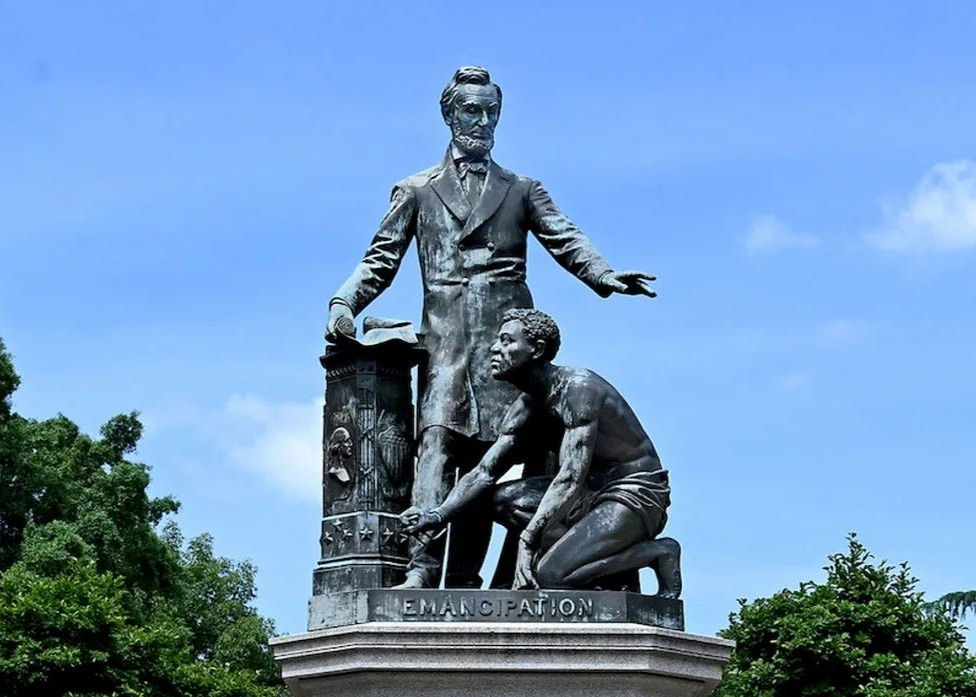
It's difficult to pick just one Lincoln site (and I have been to most of them). For me, I'm going to go with Lincoln Park on Capitol Hill.
In 1861-62 a large hospital with 2,500 beds was built a mile east of the Capitol to care for Civil War casualties. It extended for many blocks, but on the conclusion of the war it was removed. Two blocks from 11th to 13th street were made an urban park and named in honor of President Abraham Lincoln. On the 11th anniversary of his death a statue - suggested by a former slave, paid for with the contributions of former slaves, modeled on a former slave, Archer Alexander, and dedicated by perhaps the most famous former slave in the U.S., Frederick Douglass - was presented to the public.
From 1876 to 1922, the Emancipation Memorial in Lincoln Park functioned as Washington’s principal public memorial to Lincoln and likely served as the primary site where many visitors paid tribute to him before the Lincoln Memorial existed.
21st century critics have raised objections to sculptor Thomas Ball's work, claiming that it represents a black man kneeling before a white man. They fail to acknowledge the visible broken chains, the lifted knee and bent arm clearly indicating that the slave is rising, and the paper document of freedom held in Lincoln's hand. Douglass wrote, "breaking the Negro's chains was the act of Abraham Lincoln and is beautifully expressed in this monument." However, he also wished there could be a representation of a freed slave "on his feet like a man." He got his wish (partially) almost a century later when a new statuary group was dedicated in Lincoln Park. But it was an African American woman on her feet, famous civil rights leader Mary McLeod Bethune, along with a boy and girl representing the nation's youth for whom she was such great inspiration.

A personal note: From 1971 to 1985 my family and I lived in a house facing Lincoln Park; the park was essentially our front yard. The Bethune statue was placed there while we were residents.
On a somber note, I also remember the first time I visited Lincoln Park, seven years before moving into our Capitol Hill home. The occasion was to honor another martyred president. The line of mourners waiting to walk past President John F. Kennedy lying in state was a mile long. I joined that line around 8 o'clock on the evening of November 24, 1963, in Lincoln Park. Eight hours later, I walked through the Rotunda of the Capitol.

The aerial photo above shows the Lincoln sculpture at the bottom, Bethune sculpture in the middle, and our home with two pointy turrets at the top toward the left.
[Editor's note: Don't forget that the Lincoln Group of DC has a new LGDC Facebook page. Click on this link and join so you can keep up to date on all our LGDC activities. Note that this is a new Facebook page, so if you were a member of the old page, you need to sign up again!]
[All photos provided by Bob Willard]


Comments